
How Flock Safety works - and what happens to the pictures it captures.
Flock Safety automatic license plate reader (ALPR) cameras are designed to capture objective vehicle evidence that can assist investigators after a crime occurs. This page explains the process in plain language, including cloud storage, retention, access controls, and deletion.

Vehicle-Focused Technology
Encrypted Cloud Storage
30-day Retention Period
Audited Searches
What is Flock Safety?
Flock Safety is a public-safety technology platform. Its ALPR cameras use automated image capture and computer vision to record visible vehicle characteristics, including license plates, and make those observations searchable to authorized users.
Vehicle Evidence
The system is built around vehicles: license plate images, vehicle characteristics, date/time information, and the camera location associated with a detection.
Not Facial Recognition
Flock states that its ALPR system does not use facial recognition and is intended to search vehicle details rather than identify people by their faces.
Investigative Tool
Authorized users can search historical detections to help determine whether a vehicle was present in an area during a particular period.
What happens when a vehicle passes a camera?
The process is automated. The camera observes a vehicle from a location where the camera is deployed, captures a series of images, and sends the resulting data to Flock's cloud environment.
1
Vehicle enters the camera's view
The camera detects a passing vehicle using motion detection and captures images as the vehicle moves through the scene.
2
Images and vehicle data are processed
Flock's software analyzes the vehicle and plate and associates the detection with time and camera-location information.
3
Data is transmitted securely
The captured information is transmitted to Flock's cloud infrastructure using encryption in transit.
4
Authorized users can search
Users with appropriate permissions can conduct searches for legitimate law-enforcement purposes, subject to applicable policy and controls.
What is actually saved?
Flock says an ALPR detection can include the license plate image, vehicle characteristics, date and time stamps, and a camera-location identifier. The system is not designed as a continuous video surveillance system.
Important: A camera detection is a record of a vehicle passing a particular camera at a particular time. It does not, by itself, establish who was driving or where a person went before or after the detection.
How Flock Safety stores pictures
The captured images are not intended to remain permanently on the camera. Flock describes a short local-storage period followed by encrypted cloud storage.
1. Temporary Camera Storage
Flock's privacy policy states that customer data may be stored locally on the device until the device reaches storage capacity or 7 days, whichever occurs sooner. Once uploaded, the local copy is removed as part of the normal process.
3. Rolling retention
Flock's standard retention period is 30 calendar days from capture. Data is deleted automatically on a rolling basis unless a different period is required by applicable law or established by the customer's agreement or policy.
2. Encrypted cloud storage
After upload, images and associated metadata are stored in Flock's cloud environment. Flock states that data is encrypted in transit and at rest, including AES-256 encryption for stored data.
4. Deletion
Flock states that after the applicable retention period, customer data is hard deleted and is no longer accessible or retrievable through the Flock system.
30
days is the standard/default retention period.
That means a detection normally ages out of the searchable system after 30 days. A different retention period can apply when required by law or established under the applicable customer agreement or policy.
Who can access the pictures?
Access is controlled by the customer agency and its authorized users. Flock states that users are assigned role-based permissions and that searches are recorded for review.
Authorized users
Only approved users with the appropriate permissions can search the agency's Flock data. Access is not intended to be anonymous or unrestricted.
Legitimate purpose
Law-enforcement searches are subject to agency policies and Flock's controls requiring a reason for the search. Users should follow applicable constitutional, statutory, and department requirements.
Audit trail
Flock states that system searches are logged and reviewable. This creates a record of system access rather than allowing searches to occur without an audit trail.
Privacy point: Flock says customer agencies own and control their data and decide how data is shared, subject to law and the applicable agreement. Flock also states that customer data is not sold. The exact rules governing a particular camera system can depend on the agency's policies, contracts, and applicable law.
Examples of camera detections
The following images were provided for this page and show examples of Flock camera captures associated with locations in the Salem Township area.

E Front Street & Spruce Street

E Second Street & Fowler Avenue

E 8th Street & Central Avenue

E 10th Street & Central Avenue

Line Street & E 5th Street

Johnson Avenue & E 5th Street
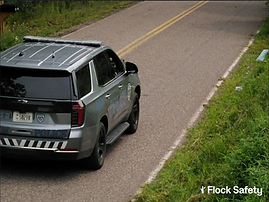
Mingle Inn Road & Moores Hill Road
